In a thirty-day window this April, four of the largest technology companies on earth independently shipped near-identical architecture for governing AI agents. Microsoft announced the Agent Governance Toolkit on April 2, anchored by a component called Agent Mesh. AWS rolled out AgentCore in stages across April 9 through 27. OpenAI shipped updated sandbox execution and persistent state primitives on April 15. Google unveiled the Gemini Enterprise Agent Platform at Cloud Next '26 on April 22 through 24, headlined by Agent Identity, Agent Registry, Agent Gateway, Agent Simulation, and Agent Observability.
No shared specification exists across these four efforts. No joint working group produced the common architecture. The companies are competitors with nothing to gain from convergence. And yet, the structural shape of what each shipped is effectively identical: cryptographic identity per agent, a central registry of agents and endpoints, a protocol-aware gateway layer, runtime memory, observability instrumentation, simulation environments, and evaluation tooling.
When four independent organizations converge on the same architecture in the same month, the explanation is not coincidence. They hit the same wall.
The Wall: Agents That Fail While Looking Correct
April 2026 produced an unusual cluster of academic papers. Eight independent research groups, working from different institutions, published findings within the same thirty-day window. The papers cover different phenomena, use different methods, and cite each other only partially. But every single one measures a version of the same thing: AI systems failing in ways that are invisible to the metrics currently used to evaluate them.
RAGEN-2, produced by researchers across Northwestern, UIUC, Stanford, Imperial College London, Oxford, the University of Washington, and Microsoft (published April 7, arXiv:2604.06268), measured what the authors call reasoning collapse in multi-turn agentic settings. Multi-turn agents drift into fluent, input-agnostic boilerplate. The outputs sound coherent. The reasoning is detached from the actual input. Standard reasoning quality metrics stay flat throughout the drift. Conditional entropy, the metric most commonly used to detect this kind of failure, cannot see it. Mutual information between input and reasoning catches it. The trace looks fine. The trace is lying.
"Dissecting Failure Dynamics in LLM Reasoning" (arXiv:2604.14528) goes further. Errors do not distribute uniformly across a reasoning trace. They originate from a small number of early-transition entropy spikes. After the first wrong turn, the model stays locally coherent while drifting globally wrong. Alternative continuations from the same intermediate state still find the correct answer. Output-level evaluation cannot distinguish between the correct path and the incorrect one once the model has committed to a direction. The GUARD framework, introduced in the same paper, intervenes at high-risk transition points specifically because the output layer provides no signal.
"When More Thinking Hurts: Overthinking in LLM Test-Time Compute Scaling" (Zhou et al., Nanjing University and Baidu, arXiv:2604.10739) measured a different failure with the same signature. Extended reasoning is associated with abandoning previously correct answers. Marginal returns from longer chains of thought diminish substantially and in some cases reverse. Stopping at moderate compute budgets often matches or exceeds full-budget accuracy. The model does not announce that it has changed its mind. It produces a different, wrong answer with equal confidence.
"LLMs Get Lost in Multi-Turn Conversation" (ICLR 2026) measured a 39% average accuracy drop between single-turn and multi-turn evaluation of the same tasks. Reliability collapsed by 112%. Larger models showed no advantage over smaller ones. Premature answer commitment, mid-context citation loss, and compounding errors without recovery all contributed. Scale does not resolve the failure.
The HORIZON benchmark, reported in "The Long-Horizon Task Mirage" (arXiv:2604.11978), tracked performance across 3,100 trajectories on GPT-5 and Claude 4 across web, operating system, embodied, and database task domains. Performance degrades non-linearly with task horizon. Sharp drops appear beyond domain-specific thresholds. Web tasks collapse at relatively short horizons. Database tasks tolerate substantially more. The degradation is not gradual. It is a cliff, and its location is domain-dependent and therefore not predictable from general benchmarks.
Three additional papers round out the cluster. "Better and Worse with Scale: Contextual Entrainment Diverges with Model Size" (Kukreja, arXiv:2604.13275) found that larger models are simultaneously four times more resistant to counterfactual misinformation and two times more prone to copying arbitrary irrelevant tokens. Semantic and non-semantic contexts scale in opposite directions. "Empirical Evidence of Complexity-Induced Limits" (Islam, arXiv:2604.13371) documented accuracy drops exceeding fifty percent at complexity thresholds across nine classical problem classes, with increased reasoning length failing to reliably improve correctness. "Measuring Reasoning Trace Legibility" (arXiv:2603.20508) found that highest-performing models rank among the lowest for trace legibility, with reward models showing no intrinsic preference for interpretable traces.
The pattern across all eight papers is consistent. Entropy stays stable. Trace length increases. Confidence rises. The output is wrong. And the metrics current agent platforms compute to detect failure cannot tell.
The Response: Four Platforms, One Architecture
The four platform launches read differently at the surface level. Microsoft's vocabulary centers on Agent Mesh, Agent Governance Toolkit, and Agent Marketplace. Google's centers on Agent Gateway, Agent Identity, and Agent Registry. AWS uses AgentCore with stateful MCP client management. OpenAI's framing focuses on sandboxed harnesses and persistent state primitives. Bain Capital's analyst team, covering the Google Cloud Next keynote, called the resulting structure "the Agentic Control Plane." Sam Charrington of TWIML described the Google offering as "the operational layer the platform has been missing." FusionAuth's read: "the keynote was built around the premise that autonomous systems need governance baked in."
Underneath the vocabulary variation, the architectural pillars are identical across all four vendors. Every platform ships cryptographic identity per agent, a central catalog of agents and endpoints, a gateway layer that enforces protocol-aware policy, runtime memory, observability tooling (Google's aligned to OpenTelemetry), simulation environments for pre-deployment testing, and evaluation infrastructure that runs outside the agent's own context. Microsoft's identity layer uses decentralized identifiers with Ed25519 cryptographic signatures and the IATP protocol. Google's uses the CNCF SPIFFE standard. The mechanism differs. The function is the same.
All four platforms moved evaluation up one layer, into something the agent cannot see or influence. That architectural choice was not accidental. It was the only structural response available to the problem the April papers measure: if the agent's outputs cannot be trusted to reflect its internal state, evaluation must happen somewhere the agent cannot reach.
The Cross-Domain Bridge: Sheridan and Runtime Assurance
The architecture these platforms converged on has a name that predates AI agents by three decades. Understanding where it came from explains why every hyperscaler arrived at the same shape independently, without a shared spec.
Thomas Sheridan at MIT published foundational work on supervisory control between 1978 and 1992. His central claim, developed across multiple papers and consolidated in "Telerobotics, Automation, and Human Supervisory Control" (1992), was structural: as automation level rises, the role of the human in the loop shifts from operator to supervisor. An operator manipulates the system directly. A supervisor monitors, diagnoses, plans, and intervenes. The two roles require fundamentally different information. Supervisory roles depend on an observability layer that the automation itself cannot provide. The automation cannot report on its own state in the terms a supervisor needs, because what is being supervised is precisely the automation's internal state representation. This is not a limitation of implementation. It is a structural property of supervisory relationships.
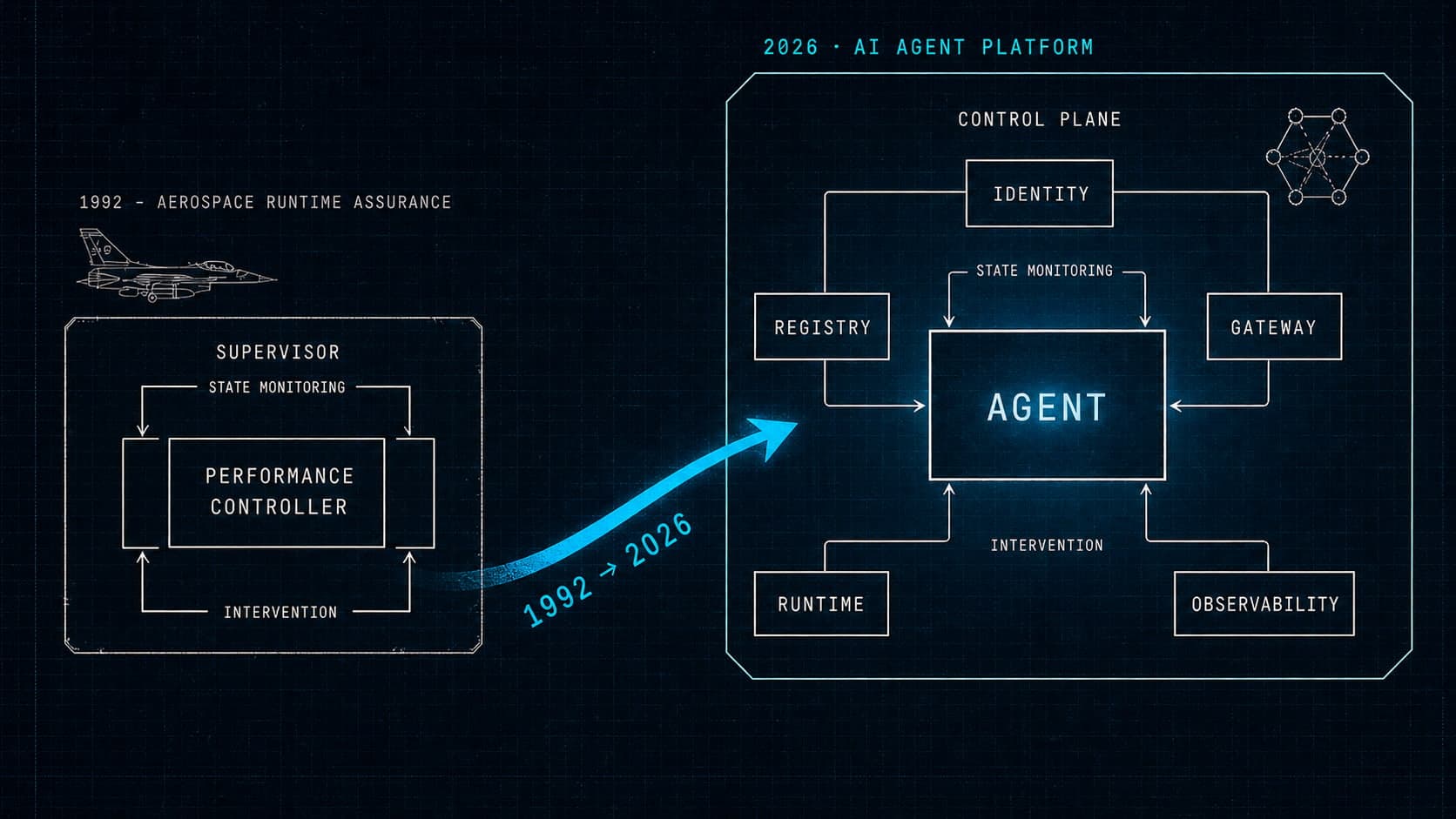
Runtime Assurance is the modern aerospace descendant of Sheridan's framework, and it is worth keeping the two distinct. Sheridan established the supervisory control paradigm. RTA is one concrete instantiation of it, developed independently in aerospace engineering over the following decades. RTA wraps an unverifiable performance controller inside a verified safety monitor. The performance controller does whatever it does. The supervisor runs in parallel, monitoring system state against invariants specified using control barrier functions. When the performance controller approaches a constraint boundary, the supervisor intervenes before the violation occurs and returns the system to safe operating conditions. The performance controller then resumes. This pattern appears in the F-16 ground collision avoidance system, NASA aerospace platforms, deep-ocean remotely operated vehicles, and bipedal robotics. The mathematical isomorphism with the 2026 agent platforms is exact, not analogical.
The agent gateways shipping in April 2026 are RTA ported to inference. The agent is the performance controller. The gateway, with its identity layer, observability instrumentation, and evaluation infrastructure, is the supervisor. The control barrier functions are replaced by policy constraints, trust-score thresholds, and behavioral invariants. The structure is the same. The engineering pressure that produced it is the same: a capable system whose internal state cannot be reliably inferred from its outputs requires an external supervisor that monitors state directly, enforces invariants, and intervenes before constraint violation.
The Gap: Chassis Shipped Before Sensors Are Validated
The hyperscaler agent platforms are real infrastructure. The identity, registry, gateway, memory, simulation, and evaluation components are shipping and being used in production deployments today. The chassis exists.
The April papers establish that the sensors are not validated. Every agent gateway on the market assumes failure is detectable from traces and outputs. The research demonstrates this assumption fails on the failure modes that matter most.
Template drift, the failure mode RAGEN-2 measures, is invisible to entropy-based metrics. A drifted agent produces the same entropy profile as a correctly reasoning one. Early-transition cascade, the failure mode described in Dissecting Failure Dynamics, occurs before any output is generated. By the time an output exists to evaluate, the incorrect reasoning path is already committed. Horizon-dependent collapse, the pattern HORIZON documents, is domain-specific. A general observability stack calibrated to average task complexity will miss cliff edges that appear only in specific task domains at specific horizons. Overthinking, the failure mode measured by Zhou et al., causes the model to abandon correct answers mid-trace. The final output is wrong. The trace that produced it appears to reflect genuine deliberation.
None of these failure modes are detectable by the observability metrics that current commercial agent gateways compute. Trace length, output correctness on evaluation sets, and token-level entropy are the primary signals the platforms currently instrument. The papers prove these signals miss the failures that matter. The chassis shipped before the sensors were validated.
The Layer: What Comes Next
There is a name for what needs to be built. Call it the supervisory signal layer. It sits between the agent gateway, which exists, and reliable agent operation, which does not yet exist at scale.
What the supervisory signal layer should contain is the next research problem. Current observability stacks compute metrics that are blind to the failure modes the April papers measure. The detector architecture that catches what those papers found is not yet shipped, not in the open-source ecosystem, and not in any of the four hyperscaler agent platforms.
The platforms are a market. The supervisory signals on top of them are not built yet. The lab that ships the layer first owns it.
Conclusion: The Architecture Rediscovered Itself
The engineering pressure that produced supervisory control theory in aerospace between 1978 and 1992 was specific: systems capable enough to perform useful work in high-stakes environments, but too complex to be safely operated from outputs alone. The human role had to shift from operator to supervisor, and supervision required an observability layer the automation could not provide for itself.
The engineering pressure producing the 2026 agent platforms is identical. The only difference is the physical substrate. The 35-year gap between Sheridan's framework and its rediscovery in AI infrastructure is not surprising. It takes time for a field to encounter the complexity thresholds at which supervisory control becomes necessary. AI infrastructure reached those thresholds this year. The architecture was waiting.
The hyperscalers built the supervisor. The April papers proved the sensors inside it are insufficient for the failure modes that matter. The supervisory signal layer is the gap between a control plane that exists and reliable agent operation that does not. That gap is where the next category lives.
Citations and Sources
arXiv Papers
- RAGEN-2: "Reasoning Collapse in Agentic RL" (Northwestern, UIUC, Stanford, Imperial College London, Oxford, University of Washington, Microsoft). arXiv:2604.06268. April 7, 2026.
- "Dissecting Failure Dynamics in LLM Reasoning." arXiv:2604.14528. April 2026.
- Zhou et al., "When More Thinking Hurts: Overthinking in LLM Test-Time Compute Scaling." Nanjing University / Baidu. arXiv:2604.10739. April 2026.
- "LLMs Get Lost in Multi-Turn Conversation." ICLR 2026. Published in industry analysis April 29, 2026.
- "The Long-Horizon Task Mirage" (HORIZON benchmark, 3,100+ trajectories). arXiv:2604.11978. April 2026.
- Kukreja, "Better and Worse with Scale: Contextual Entrainment Diverges with Model Size." arXiv:2604.13275. April 14, 2026.
- Islam, "Empirical Evidence of Complexity-Induced Limits." arXiv:2604.13371. April 15, 2026.
- "Measuring Reasoning Trace Legibility" (90k traces, 12 reasoning language models). arXiv:2603.20508. 2026.
Vendor Announcements
- Microsoft Agent Governance Toolkit (Agent Mesh, Agent Compliance, Agent Marketplace). April 2, 2026.
- AWS Bedrock AgentCore CLI and features (stateful MCP clients, exportable orchestration). April 9-27, 2026.
- OpenAI Agents SDK update (sandbox execution, persistent state primitives, controllable memory). April 15, 2026.
- Google Cloud Next '26: Gemini Enterprise Agent Platform (Agent Identity, Agent Registry, Agent Gateway, Agent Observability, Agent Simulation, Agent Evaluation). April 22-24, 2026.
Cross-Domain Reference
- Thomas B. Sheridan, "Telerobotics, Automation, and Human Supervisory Control." MIT Press, 1992.