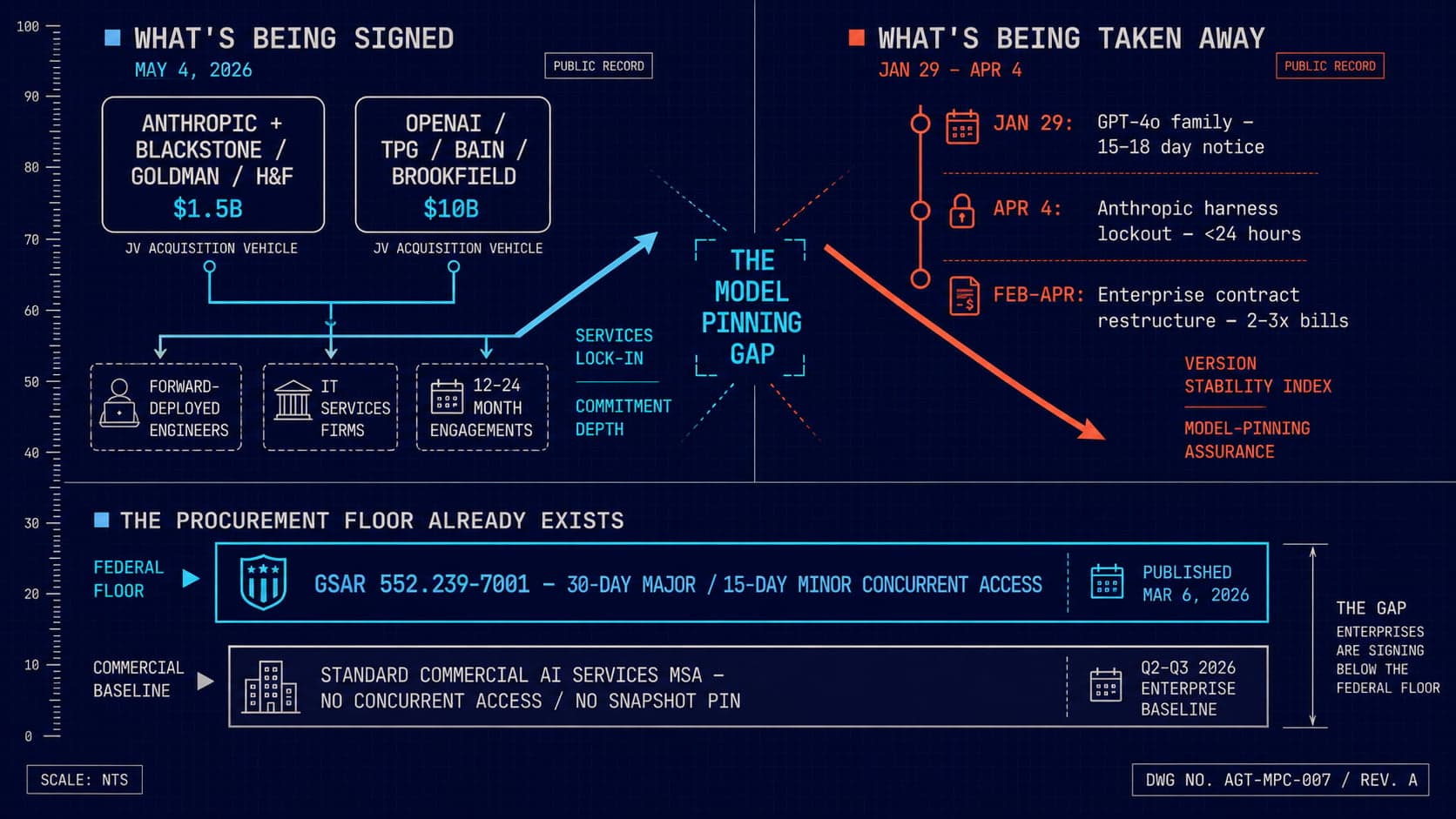
On May 4, 2026, Anthropic and OpenAI announced two enterprise services joint ventures within the same hour. Anthropic with Blackstone, Hellman and Friedman, and Goldman Sachs put $1.5 billion behind a vehicle that targets PE portfolio companies between $100 million and $5 billion in revenue. OpenAI with TPG, Bain Capital, Brookfield, and Advent put roughly $10 billion behind an entity branded "The Deployment Company." Both vehicles are explicitly designed to acquire IT services and consulting firms.
The Anthropic vehicle is structured with $300 million each from Anthropic, Blackstone, and Hellman and Friedman, plus $150 million from Goldman, with additional capital from GIC, Apollo, General Atlantic, Leonard Green, and Sequoia. The model is forward-deployed engineers embedded inside acquired services firms. The OpenAI vehicle has OpenAI itself contributing $500 million with a $1 billion option. Reuters reported on May 5 that the OpenAI side is already in advanced stages on three services-firm acquisitions.
Both vendors are leaning into the implementation layer at scale. Multi-year deployments. Embedded engineers. Acquired consulting firms. Deeper customer switching costs. The strategic logic is consistent and visible. This is vendors trying to capture the services revenue line that historically went to systems integrators, and using their model relationships to anchor it.
The timing is the story. These same two vendors' contractual model-version stability has deteriorated to its weakest posture in eighteen months. The buyer is being asked to commit to deeper services lock-in with a vendor whose underlying instrument keeps changing under them on 15 to 90-day notice. The two facts arrived in the same 90-day window. They do not fit together. This piece names the model pinning gap and walks the procurement floor that already exists for it.
What The Same Vendors Have Done To Version Stability
On January 29, 2026, OpenAI announced retirement of GPT-4o, GPT-4.1, GPT-4.1 mini, and o4-mini with 15 to 18 days of notice. The byteiota account flagged the same day that this directly contradicted Sam Altman's prior public pledge: "if we ever do deprecate it, we will give plenty of notice." Three weeks of notice on a foundational model line was the published floor. The pledge was broken on the record.
On April 4, 2026, Anthropic gave Claude Pro and Max subscribers less than 24 hours of notice before third-party agent harnesses including OpenClaw and similar runtimes lost subscription quota access. Subscribers who had built workflows on those harnesses had a one-day window to react. The refund window stayed open through April 17. Anton Zagrebelny's April 30 piece "The April every AI plan broke" walked the same event for paid users on the API side. The harness lockout was not a rate adjustment. It was a category change in what the subscription tier permitted.
Between February and April 2026, Anthropic restructured its enterprise contracts. The Information reported on April 14, with Fredrik Filipsson's Redress Compliance follow-up cataloguing the change in detail. The previous flat $200 per seat per month with discounted token allowance is gone.
The replacement is $20 per seat plus standard API rates plus a forced monthly commitment. Volume discounts of 10 to 15 percent are gone. Heavy enterprise users now see bills double or triple under the new structure, on the same workloads.
Anthropic's own deprecation table tracks the cadence under which named model snapshots retire. The April 27 piece by Tianpan, "Model Deprecation Treadmill," catalogs the current windows. claude-opus-4-20250514 was deprecated on April 14, 2026 and is scheduled to retire on June 15, 2026. That is 62 days from deprecation announcement to retirement on a flagship snapshot. The successor windows narrow further on minor versions.
Three independent surfaces moved against version stability in the same quarter: a 15 to 18-day deprecation window on OpenAI's foundational line, a sub-24-hour change to subscription scope on Anthropic's consumer plan, and a contractual restructure on Anthropic's enterprise plan that 2 to 3x's bills for heavy users. The pattern is consistent across vendor, across customer segment, and across product line. It is not a one-shot event.
A vendor that runs 15-day deprecations and silent contract restructures has a different posture toward its customers than one that runs 90-day deprecations and pinned snapshots. The May 4 services JV announcements ask buyers to deepen their dependence on the first kind of vendor. The procurement question is whether the contracts attached to those JV engagements look like 90-day-deprecation contracts or 15-day-deprecation contracts. Most of them, today, look like the second.
Why These Two Facts Don't Fit Together
Vendors leaning into services revenue is not new. Consulting firms have always provided implementation services. The objection writes itself: this is just vertical integration. The vendor wants the services margin. The customer gets a tighter integration. Both sides win.
The objection misses the magnitude and the timing. Two of the largest enterprise-AI deals of 2026 launched the same day. Both are designed as acquisition vehicles for IT services and consulting firms. Both vendors run forward-deployed engineer models inside acquired firms. Both target multi-year embedded deployments where the customer's operational dependence on the vendor's specific model behavior compounds quarter by quarter.
The synchronized vendor moves arrived in the same 90-day window as the synchronized stability erosion. That pairing is the structural mismatch. The customer is being asked to sign a multi-year services engagement whose primary deliverable, the vendor's specific model behavior under specific prompts and tools, can be unilaterally altered every quarter. The financial commitment lengthens. The contractual stability of the underlying instrument shortens. The two trends point in opposite directions and the contract documents being signed in May 2026 do not reconcile them.
The April Pricing Collapse piece in this series traced a related mismatch on a different surface. Vendors moved on pricing shape in a 30-day window in April 2026. Atonement Licensing's audit of 40-plus enterprise contracts found that almost no signed contract had the audit-rights clauses needed to survive that move. The vendor side moved. The deployer side did not. The same shape repeats here on a different contractual surface: version stability rather than pricing structure, services lock-in rather than seat economics. The contractual primitives that solve it are different. The buying-window logic is identical.
The Federal Procurement Floor
On March 6, 2026, the General Services Administration published proposed clause GSAR 552.239-7001 as part of the GSAR rulemaking process. Public comments closed April 3. The clause is currently deferred to MAS Refresh 32 for final issuance, but the language is on the record and is being treated by federal contracting officers as the working draft. The Crowell client alert on March 13, the Jenner client alert that followed, the Baker Botts April 14 update, and the Statt April 2 explainer are the canonical professional-services walkthroughs.
The clause's load-bearing requirement is "comprehensive concurrent access" to successor models before discontinuation. Thirty days for major versions. Fifteen days for minor versions. Seven days from the contractor identifying any change to the procurement office. The clause defines what "major" and "minor" mean for purposes of the obligation, which itself is a meaningful fixture. Most commercial AI contracts give the buyer neither parallel-access window nor a definition of which version classification applies.
Walk the existing commercial reference points. OpenAI's Scale Tier publishes 99.9 percent uptime, dated snapshots like gpt-4o-2024-11-20 available at the contract level, with deprecation notice typically 90 days for snapshots, six to twelve months for foundational models, and 14 days for ChatGPT-only models.
Anthropic enterprise, per agentmarketcap.ai's April 11 walkthrough, publishes 99.99 percent uptime as a negotiated term, with no published deprecation policy and 60 to 90 days of notice in practice for major model retirements. Snapshot pinning is negotiated, not default. Azure OpenAI publishes 60 days minimum on GA models and 30 days on preview. Google Vertex AI publishes a 6-month standard on GA models.
The federal floor is sharper than any commercial reference point currently in the market. Thirty days of guaranteed parallel access on major versions, in writing, with a contractually-defined trigger and a contractually-defined notice obligation, exceeds what any commercial AI services contract gives the deployer by default. The thirty-day window is also the floor, not the ceiling. The clause permits the procurement officer to negotiate longer windows on critical workloads. Almost no commercial AI services contract being signed in May 2026 contains the equivalent language at any duration.
The clause is not academic. Crowell's March 13 client alert flagged that contractors bidding on GSA AI vehicles will have to demonstrate they can meet the concurrent-access obligation as a condition of award. Jenner's analysis treats it as the de facto procurement standard for federal AI contracts going forward. Baker Botts' April 14 update extended the analysis to defense and intelligence-community vehicles, where the concurrent-access requirement has been treated as live procurement language even before MAS Refresh 32 closes the formal rulemaking.
This is a federally-drafted procurement primitive. The buyer-side question for May 2026 is straightforward: if the federal government wrote the clause, why is the equivalent missing from the multi-year services engagement a Fortune 500 CIO is being asked to sign next month with a vendor whose deprecation cadence ran 15 days in January?
What It Looks Like In Production
The practitioner case worth naming is from May 5, 2026. Onkar Mane, posting as @theonkartwt on X, walked through what happened to a client that swapped its underlying LLM in January 2026. The hallucination rate jumped from 8 percent to 22 percent on the production workload. The AI began citing API parameters that did not exist. Developers, working in the codebase the AI assistant had been assisting, blindly copied the broken code into production. The change went undetected for six weeks. Support tickets rose 40 percent. The client lost one enterprise customer. Three weeks of engineering time burned on the cleanup.
GG_Observatory's May 6 follow-up named the technical mechanism with precision. Behavioral diffing was absent from the eval suite. The silent model swap broke developer-copied production code with no errors and no alerts. The eval coverage that existed measured input-output correctness on a fixed dataset. It did not measure whether the model's behavior on a representative slice of production traffic had drifted relative to a reference snapshot. Without behavioral diffing, the silent swap is invisible until production users hit it.
Advik Jain, posting as @advikjain_ on May 5, named a parallel pattern from the procurement-evaluation side. Across six AI vendor evaluations he ran in the prior quarter, the losing competitors had one phrase in common: "we'll figure that out together," delivered in response to year-three TCO questions, retraining cadence questions, or month-twelve handoff questions. The phrase signals the absence of a contractual answer where the buyer needs one. The vendors that had written answers won the deals. The vendors that punted lost.
These are not edge cases. They are the predictable consequence of the contractual posture. A buyer who has not pinned the model snapshot at the contract level cannot detect a silent swap when it happens. A buyer who accepts "we'll figure that out together" in response to a year-three model-stability question is signing into a multi-year engagement with no enforceable answer to the question the federal government already wrote a clause to solve.
The Onkar Mane case is what this looks like with one missing piece of operational discipline and one missing piece of contractual language. Eight percent to 22 percent hallucination, six weeks undetected, one enterprise customer lost, three weeks of engineering rebuilt. The next case will be worse because the next contract being signed has multi-year services exposure with embedded engineers attached to the vendor's quarterly model-change cadence.
The Buying Posture For Q2 And Q3 2026
The buying advantage is in the gap between vendor and deployer moves. The vendor side has moved twice in 2026, first on pricing shape in April and now on services depth in May. The deployer side has not moved on either. Six concrete actions follow for any CIO, CFO, COO, or AI procurement lead signing or renewing an Anthropic-services-firm or OpenAI-Deployment-Company engagement in the next two quarters.
Concurrent Access as a non-negotiable MSA clause. Adopt the GSA-style language directly: 30 days of concurrent parallel access to successor models on major version transitions, 15 days on minor, 7 days from the vendor identifying any change. This sits at the master agreement level, not in the statement of work. Every services engagement under that master agreement inherits the obligation. The clause is the procurement floor the federal government already named. The vendor's first response will be that this is not standard. It is standard at GSA. Hold the line.
Snapshot Pinning at the contract level. The buyer commits to a named version of the underlying model, dated, for the life of the engagement. Not the runtime toggle in the vendor's console, which the vendor can change unilaterally, but the contractual commitment to a specific dated snapshot like claude-sonnet-4-5-20250929 or gpt-5-2025-08-07. Migration to a successor snapshot is a contractual event with notice, evaluation, and rollback rights, not a deployment-day surprise.
Automated weekly behavioral-diffing eval keyed to the pinned snapshot. This is the operational pairing the legal clauses require. Without an eval suite that runs a representative production-traffic sample against the pinned snapshot every week and flags drift, the contract clause is decorative. Behavioral diffing measures whether the model's behavior on the workload has changed, not whether the model passes a fixed input-output test. The Onkar Mane case is what happens when the eval suite measures only the second and not the first. The fix is platform-level, not vendor-level. Whether you run the eval through Braintrust, LangSmith Enterprise, Arize, or a self-hosted alternative, the discipline is the load-bearing piece, not the platform.
RFP scoring criteria additions. Concurrent Access and Snapshot Pinning sit on the scorecard alongside the audit-rights items from the Pricing Collapse piece in this series. A vendor that refuses both is not a vendor that has earned a multi-year services engagement with embedded engineers. A vendor that accepts both at the master-agreement level is one that has signaled it intends to operate the relationship in the procurement-grade posture the contract describes.
Quarterly vendor stability review at the board level. Because the deprecation cadence of frontier model vendors now runs on a quarterly cycle, the deployer's review cadence should match. The standing review pulls the vendor's published deprecation table, the deployer's pinned snapshots, the diffing eval's drift metrics, and the upcoming forced-migration calendar. The output is a board-visible risk view of which workloads are exposed, which contracts have the clauses, and which renewals open in the next two quarters. Vendor stability is now a CFO-grade reporting line, not an engineering footnote.
Reframe the services engagement budget as 12-to-24-month exposure with quarterly model-change events, not as a one-time integration cost. The Anthropic and OpenAI services JVs are designed as multi-year deployments. The model behavior under those deployments will change four to eight times across the engagement window on current cadences. The CFO's view of services-engagement cost should price the model-change event count, the diffing-eval headcount, and the worst-case snapshot-migration project the deployer might have to absorb under the contract. Treat it as variable services cost over a multi-year horizon, not as a fixed integration line.
Each of these is concrete. None requires technical specialization to act on. The hardest one is the first, because the vendor's commercial team will resist 30-day concurrent access at the master-agreement level. The hardest one is also the most important. Without it, the rest are decorative.
Connection To The Pricing Collapse
The Pricing Collapse piece in this series, published May 5, 2026, was about MFN clauses, audit rights, and the contractual primitives missing from existing AI contracts when the vendor pricing shape changed in April. The Model Pinning Crisis is about version stability and concurrent access on the new services contracts being signed at scale this quarter. Same tier-2 audience. Different decision. Different contractual surface. Both pieces describe a structural mismatch between vendor moves and deployer-side contractual posture.
Read together, the two pieces give a CIO, CFO, or General Counsel a complete procurement framework for AI contracts in 2026. The Pricing Collapse names the three audit-rights clauses that protect the existing contract portfolio: model version pin, token-rate MFN, and IP indemnity. The Model Pinning Crisis names the two version-stability clauses that protect the new services engagements: concurrent access and snapshot pinning. The five clauses together are the procurement floor. The audit, redline, and instrumentation actions that follow are the same. The difference is which contractual surface each pair of clauses sits on.
A buyer who has the audit-rights clauses but not the version-stability clauses can still get a 15-day deprecation surprise on a multi-year services engagement. A buyer who has the version-stability clauses but not the audit-rights clauses can still get a 2 to 3x bill increase at renewal. The full set is required because the vendor side has moved on both surfaces in the same quarter. Reading either piece without the other gives the buyer half a procurement framework in a market that has fully shifted on both.
The Closing Claim
The federal government already wrote the procurement floor. GSAR 552.239-7001 names 30-day concurrent access on major versions, 15-day on minor, 7-day contractor notice on any change. The clause is on the record. Public comments closed April 3. The legal-services walkthroughs have been published since March. Federal contractors are already being asked to demonstrate the obligation as a condition of award.
Enterprise buyers have not asked for it. The May 4 services JVs are being signed without the equivalent language. Q2 and Q3 of 2026 is the window before this becomes either a known requirement, in which case enterprise procurement adopts the federal floor as the commercial standard, or a crisis playing out across multiple Fortune 500 procurement audits, in which case the audit reveals what the contracts did not contain. The vendor side has already moved. The deployer side has not. The window between those two moves is the buying advantage. Use it.
Citations And Sources
Vendor services JV launches
- Anthropic press, May 4, 2026. ($1.5B services vehicle with Blackstone, Hellman and Friedman, Goldman Sachs, plus GIC, Apollo, General Atlantic, Leonard Green, Sequoia.)
- Blackstone press, May 4, 2026. (Forward-deployed engineer model targeting PE portfolio companies $100M to $5B revenue.)
- Goldman Sachs press, May 4, 2026.
- GIC press, May 4, 2026.
- WSJ, "Anthropic and Blackstone team on AI services vehicle." May 5, 2026.
- Reuters, "OpenAI Deployment Company in advanced stages on three services-firm acquisitions." May 5, 2026. (~$10B vehicle with TPG, Bain, Brookfield, Advent; OpenAI $500M with $1B option.)
- Fortune, "The two services JVs that landed the same day." May 5, 2026.
Vendor deprecation behavior
- byteiota on X, January 30, 2026. (OpenAI 15 to 18-day retirement notice for GPT-4o, GPT-4.1, GPT-4.1 mini, o4-mini; Altman pledge contradiction.)
- Anton Zagrebelny, "The April every AI plan broke." April 30, 2026. (Anthropic April 4 sub-24-hour harness lockout for Pro and Max subscribers; OpenClaw and similar third-party harnesses; refund window through April 17.)
- The Information, "Anthropic restructures enterprise contracts." April 14, 2026. ($200/seat flat plus token allowance replaced with $20/seat plus standard API rates plus forced monthly commitment; 10 to 15 percent volume discounts removed; 2 to 3x bills for heavy users.)
- Fredrik Filipsson, Redress Compliance. "Anthropic enterprise contract restructure walkthrough." April 14 onward, 2026.
- Tianpan, "Model Deprecation Treadmill." April 27, 2026. (
claude-opus-4-20250514deprecated April 14, retiring June 15, 2026 = 62 days.)
Federal procurement reference clause
- GSA, GSAR 552.239-7001 proposed clause. Published March 6, 2026; comments closed April 3; deferred to MAS Refresh 32. ("Comprehensive concurrent access" requirement: 30 days major / 15 days minor / 7 days contractor notice.)
- Crowell client alert, March 13, 2026. (Concurrent-access obligation as condition of award on GSA AI vehicles.)
- Jenner client alert, March 2026. (De facto procurement standard for federal AI contracts.)
- Baker Botts client update, April 14, 2026. (Defense and IC vehicle treatment ahead of formal MAS Refresh 32 close.)
- Statt, April 2, 2026. (Public-facing explainer.)
Commercial AI contract reference points
- agentmarketcap.ai, April 11, 2026. (OpenAI Scale Tier 99.9 percent uptime; dated snapshots; 90-day snapshot deprecation; 6 to 12-month foundational; 14-day ChatGPT-only. Anthropic enterprise 99.99 percent negotiated; 60 to 90 days in practice; snapshot pinning negotiated not default. Azure OpenAI 60 days GA, 30 days preview. Google Vertex AI 6 months on GA.)
Production case and procurement-evaluation patterns
- Onkar Mane, @theonkartwt on X. May 5, 2026. (Client model swap January 2026; hallucination rate 8 percent to 22 percent; cited API parameters that did not exist; developers copied broken code to production; undetected 6 weeks; support tickets up 40 percent; lost one enterprise customer; 3 weeks engineering time burned. https://x.com/theonkartwt/status/2051707764913963071)
- GG_Observatory follow-up, May 6, 2026. (Behavioral diffing absent from eval suite; silent swap broke developer-copied production code with no errors or alerts.)
- Advik Jain, @advikjain_ on X. May 5, 2026. (Six AI vendor evaluations; losing competitors shared the phrase "we'll figure that out together" on year-three TCO, retraining cadence, and month-twelve handoff questions. https://x.com/advikjain_/status/2051669366522167380)
Prior Signal in this series
- Diamond, Beau. "The Pricing Collapse." beaudiamond.ai/signal/the-pricing-collapse. May 5, 2026.
- Diamond, Beau. "The CLS Rediscovery." beaudiamond.ai/signal/the-cls-rediscovery. May 6, 2026.
- Diamond, Beau. "The Routing Failure." beaudiamond.ai/signal/routing-failure. May 4, 2026.
- Diamond, Beau. "The Supervisory Signal Layer." beaudiamond.ai/signal/supervisory-signal-layer. May 1, 2026.
- Diamond, Beau. "The Cognitive State Layer." beaudiamond.ai/signal/cognitive-state-layer. April 30, 2026.